




This guide covers the City of Charleston, South Carolina. STR rules differ in these nearby markets, which are often confused with Charleston:
- North Charleston: Separate city with its own STR rules and enforcement.
- Mount Pleasant: Distinct municipality east of the Cooper River, with its own STR ordinance.
- Isle of Palms: Barrier island with unique, often stricter, STR regulations.
- Folly Beach: Beach town south of Charleston, with its own STR caps and permitting process.
Legality Verdict
Short-term rentals are legal in Charleston, SC, but only as owner-occupied units with strict permitting, a 14% tax stack, and robust enforcement. Whole-house STRs are banned. Investors face high compliance costs and operational constraints.
- Legality Status: 2/5
- License Availability: 4/5
- Compliance Cost (% revenue): 2/5
- Regulatory Stability: 4/5
- Enforcement Climate: 2/5
TL;DR
Charleston defines STRs as rentals under 30 days and requires both a Short Term Rental Permit and a business license. The total tax burden is 14% of gross revenue. Only owner-occupied STRs are allowed—whole-house rentals are banned. The permit process includes a $345 application fee, fire inspection, and annual renewal. The biggest gotcha: non-owner-occupied STRs are strictly prohibited and enforcement is active.
Quick Facts
| Item | Detail |
|---|---|
| STR Definition | Rental of a dwelling for less than 30 consecutive days City of Charleston, SC – Official Website |
| Registration Required | Yes — STR Permit and Business License required City of Charleston, SC – Official Website |
| Permit Cost | $345 zoning/application review fee City of Charleston, SC – Official Website |
| Fire Inspection Fees | $40 application, $32.61 plan review, $32.61 inspection City of Charleston, SC – Official Website |
| Business License Fee | $64 base + $3.90 per $1,000 of expected income City of Charleston, SC – Official Website |
| Annual Renewal | Yes — by original permit date City of Charleston, SC – Official Website |
| License Cap | Not codified — no citywide cap found in available sources City of Charleston, SC – Official Website |
| Transferability | Not codified — transfer policy not stated in available sources City of Charleston, SC – Official Website |
| State Sales Tax | 5% South Carolina Department of Revenue |
| State Accommodations Tax | 2% South Carolina Department of Revenue |
| Charleston County Accom. Tax | 2% Charleston County Government |
| City of Charleston Accom. Tax | 2% City of Charleston Official Website |
| Total Effective Lodging Tax | 6% (accommodations-specific) City of Charleston Official Website |
| Total Tax Burden (all taxes) | 14% City of Charleston Official Website |
| Occupancy Cap | Not codified — see city ordinance for details City of Charleston, SC – Official Website |
| Parking Requirement | 1 off-street space per STR, plus required parking for existing uses City of Charleston, SC – Official Website |
| Owner-Occupancy Requirement | Yes — only owner-occupied STRs allowed STR Agent Hub |
| Local Contact Requirement | Not codified — see city ordinance for details City of Charleston, SC – Official Website |
| Inspection Requirement | Yes — fire inspection required City of Charleston, SC – Official Website |
| Enforcement Penalties | Fines up to $500 per violation; permit revocation for repeat offenses Home Team Luxury Rentals |
| Primary Regulator | City of Charleston Permit Center, 2 George St, Suite 3700, (843) 724-3711 City of Charleston, SC – Official Website |
| Last Updated | June 11, 2026 |
Regulatory Impact Snapshot
Charleston’s STR regime is defined by high compliance costs and strict owner-occupancy rules. Underwriters should model compliance costs at 14.7% of gross revenue, with median Charleston, SC STRs earning $59,479 at an average daily rate of $298 and 59% occupancy. The binding constraint is the owner-occupancy requirement—whole-house STRs are banned, and enforcement is active. The 14% tax stack and layered permit/inspection fees further compress margins. Investors must factor in annual renewals, business license fees, and the risk of permit revocation for violations. Run this market in our Airbnb Calculator →
Top 500 US Airbnb Rental Markets - 2026
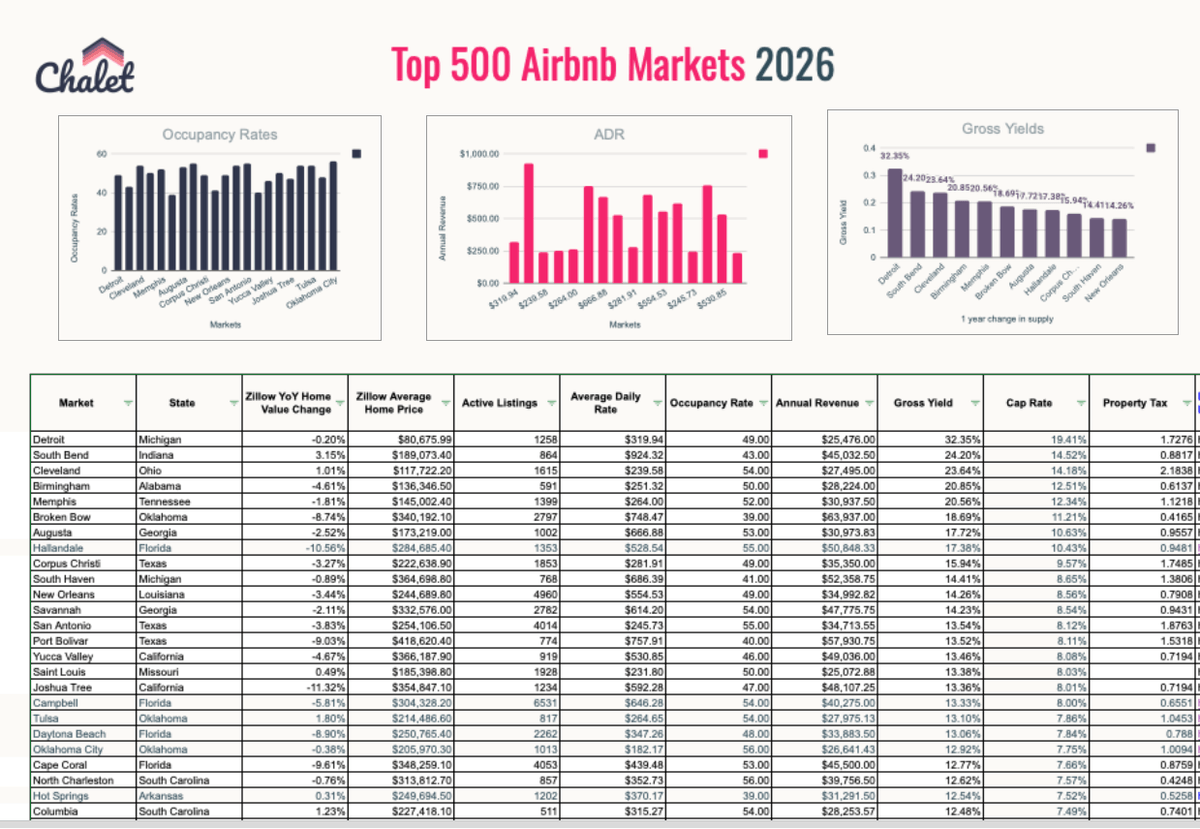
Instantly compare top 500 short-term (Airbnb) rental markets in the US
Frequently Asked Questions
Basics
What is considered a short-term rental in Charleston, SC?
A short-term rental is defined as renting a dwelling for less than 30 consecutive days within the City of Charleston City of Charleston, SC – Official Website.
Are short-term rentals legal in Charleston, SC?
Yes, but only as owner-occupied units. Whole-house STRs are banned and enforcement is strict STR Agent Hub.
Licensing
What permits are required to operate an STR in Charleston?
You must obtain both a Short Term Rental Permit and a City of Charleston Business License City of Charleston, SC – Official Website.
How much does it cost to get an STR permit?
The zoning/application review fee is $345, plus fire inspection fees and a business license fee City of Charleston, SC – Official Website.
Is there a cap on the number of STR permits?
No citywide cap is codified in available sources City of Charleston, SC – Official Website.
Are STR permits transferable to new owners?
Not codified — transfer policy is not stated in available sources City of Charleston, SC – Official Website.
Taxes
What is the total tax burden for STRs in Charleston?
The total tax burden is 14%, including state sales tax, accommodations taxes, and local levies City of Charleston Official Website.
Which taxes does Airbnb collect and remit?
Airbnb collects and remits state sales tax (5%), state accommodations tax (2%), Charleston County accommodations tax (2%), and City of Charleston accommodations tax (2%) Airbnb Help Center.
Do I need a South Carolina Retail License?
Yes, STR operators must obtain a South Carolina Retail License to collect and remit taxes South Carolina Department of Revenue.
Operations
Is owner-occupancy required for STRs?
Yes, only owner-occupied STRs are permitted; the owner must be present during guest stays STR Agent Hub.
What are the parking requirements?
Each STR must provide one off-street parking space in addition to required parking for existing uses City of Charleston, SC – Official Website.
Are fire inspections required?
Yes, a fire inspection and plan review are mandatory before receiving an STR permit City of Charleston, SC – Official Website.
Is there an occupancy limit?
Not codified in available primary sources; check the city ordinance for details City of Charleston, SC – Official Website.
Enforcement
What are the penalties for violating STR rules?
Fines can reach up to $500 per violation, and repeat offenses may result in permit revocation Home Team Luxury Rentals.
How is STR compliance enforced?
Charleston uses dedicated staff and technology to monitor compliance, including detection of unpermitted listings Home Team Luxury Rentals.
Are illegal STRs grandfathered in?
No, operating without a permit or violating regulations will result in enforcement actions Home Team Luxury Rentals.
Who is the primary regulator?
The City of Charleston Permit Center at 2 George St, Suite 3700, (843) 724-3711 City of Charleston, SC – Official Website.
Permit Process
Charleston requires both a Short Term Rental Permit and a business license to operate legally. The permit process includes a $345 zoning/application review fee, fire inspection fees, and a business license fee based on expected income. All permits must be renewed annually by the original date of issuance. The process is managed by the City of Charleston Permit Center City of Charleston, SC – Official Website.
Zoning
STRs are only allowed as owner-occupied units. Each property may have only one STR unit, and must provide one off-street parking space in addition to required parking for existing uses. Category 1 STRs (Old and Historic District) must be in a structure listed on the National Register of Historic Places, while Category 2 STRs must be in buildings at least 50 years old City of Charleston, SC – Official Website.
Taxes and Remittance
Charleston STRs face a 14% total tax burden, including 5% state sales tax, 2% state accommodations tax, 2% Charleston County accommodations tax, and 2% City of Charleston accommodations tax. Airbnb collects and remits these taxes, but hosts are responsible for ensuring all required taxes are paid. A South Carolina Retail License is required for tax remittance City of Charleston Official Website.
Enforcement and Recent Actions
Charleston enforces STR rules with fines up to $500 per violation and possible permit revocation for repeat offenses. The city uses dedicated staff and technology to monitor compliance, and illegal STRs are not grandfathered in. Enforcement actions may include court summons for serious or repeated violations Home Team Luxury Rentals.
Recent Changes and Pending Legislation
Charleston’s current STR ordinance has been in effect since July 2018. Multiple state bills to preempt local STR bans have been introduced but not enacted as of June 2026. Charleston County is considering amendments to strengthen enforcement against unpermitted STRs, including a two-year application ban for violators South Carolina Legislature Online.
Comparable Markets
- Mount Pleasant, SC: Consider if you want a suburban market with its own STR ordinance.
- Folly Beach, SC: Consider if you seek a beach town with strict STR caps.
- Isle of Palms, SC: Consider for high-end, highly regulated coastal STRs.
Sources
- City of Charleston, SC – Official Website: https://www.charleston-sc.gov/1840/Short-Term-Rental-Permit-Information
- City of Charleston, SC – Official Website: https://www.charleston-sc.gov/1855/Applicable-Fees
- City of Charleston, SC – Official Website: https://www.charleston-sc.gov/134/Business-License-Information
- City of Charleston, SC – Official Website: https://www.charleston-sc.gov/2529/Short-Term-Rental-Ordinance
- City of Charleston, SC – Official Website: https://www.charleston-sc.gov/2316/Category-Criteria
- City of Charleston Official Website: https://www.charleston-sc.gov/2339/Accommodations-Tax-for-STRs
- Charleston County Government: https://www.charlestoncounty.gov/departments/revenue-collections/local-accommodations-tax-application.php
- South Carolina Department of Revenue: https://dor.sc.gov/tax/accommodations
- South Carolina Legislature Online: https://www.scstatehouse.gov/sess126_2025-2026/bills/3861.htm
- Airbnb Help Center: https://www.airbnb.com/help/article/2328
- STR Agent Hub: https://stragenthub.com/regulations/charleston-sc-airbnb-regulations
- Home Team Luxury Rentals: https://hometeamluxuryrentals.com/management/south-carolina/charleston/regulations
- Live 5 News: https://www.live5news.com/2026/02/10/charleston-county-works-close-short-term-rental-loophole/
This page is research, not legal advice. Consult local counsel before acquiring or operating a short-term rental in City of Charleston, Charleston County, South Carolina.
Ready to evaluate Charleston as an STR market?
- See Charleston revenue data → — Get live median revenue, occupancy, and ADR for Charleston STRs.
- Run this deal in our calculator → — Model cash flow and compliance costs for your Charleston property.
- Match with a Charleston STR agent → — Connect with a local expert for on-the-ground guidance.