



This guide covers the City of Chicago, Illinois only. Neighboring or similarly-named markets have separate STR rules. Commonly confused sibling markets include:
- West Chicago: A separate city in DuPage County, not part of Chicago or Cook County.
- North Chicago: An independent city in Lake County, north of Chicago proper.
- Chicago Ridge: A distinct suburb southwest of Chicago, with its own municipal code.
- Cicero: A large incorporated town bordering Chicago, governed by its own ordinances.
Legality Verdict
Short-term rentals are legal in Chicago with strict licensing, a 27.75% tax stack, and building-level caps. Localized bans and ongoing amendments create regulatory risk for investors.
- Legality Status: 4/5
- License Availability: 4/5
- Compliance Cost (% revenue): 1/5
- Regulatory Stability: 2/5
- Enforcement Climate: 3/5
TL;DR
Chicago defines STRs as rentals under 32 days. Registration is mandatory, with a $125 fee for single units or $250 for multi-unit operators (valid two years). The total effective lodging tax is 27.75%. No citywide cap, but only 6 units or 25% per building. The biggest investor risk: precinct-level bans and ongoing local amendments can abruptly restrict STR operations.
Quick Facts
| Item | Detail |
|---|---|
| STR Definition | Rental of a dwelling unit for fewer than 32 consecutive days (Checkmate Rentals) |
| Registration Required | Yes (Truvi) |
| Permit Cost | $125 (single unit); $250 (multi-unit, 2-year license) (Truvi) |
| Annual Renewal | Not codified — 2-year license for $250 (Truvi) |
| License Cap | No citywide cap; max 6 units or 25% per building (Truvi) |
| Transferability | Not transferable (Truvi) |
| Primary Residence Rule | Required for single-family and 2–4 unit buildings; not required in 5+ unit buildings (Truvi) |
| Local Contact Requirement | Yes (Truvi) |
| Inspection Requirement | Not codified — general building/fire code applies (Municipal Code of Chicago) |
| Occupancy Cap | Not codified — state/building code applies (Municipal Code of Chicago) |
| Parking Requirement | Not codified — general zoning applies (Municipal Code of Chicago) |
| HOA/Condo Override | Not codified — private covenants may apply (Municipal Code of Chicago) |
| Permitted Zones | All except Restricted Residential Zones (Truvi) |
| Prohibited Zones | Restricted Residential Zones; 2,300+ prohibited buildings (Truvi) |
| Enforcement Penalties | $2,500–$10,000 per offense; license suspension/revocation (Avalara) |
| State Sales Tax | 10.25% (City of Chicago Office of Financial Analysis) |
| State Hotel Tax | 6% of 94% of gross receipts (Illinois Dept. of Revenue) |
| Local Accommodations Tax | 4.5% (City of Chicago Office of Financial Analysis) |
| Shared Housing Surcharge | 4% (City of Chicago Office of Financial Analysis) |
| Domestic Violence Surcharge | 2% (City of Chicago Office of Financial Analysis) |
| County Hotel Tax | 1% (City of Chicago Office of Financial Analysis) |
| Total Effective Lodging Tax | 27.75% (City of Chicago Office of Financial Analysis) |
| Primary Regulator | Chicago Dept. of Business Affairs and Consumer Protection (City of Chicago Business License Forms) |
| Last Updated | June 11, 2026 |
Regulatory Impact Snapshot
Chicago’s STR regime is defined by a 27.75% total tax burden and strict building-level caps. Permit fees are $125 for single units or $250 for multi-unit operators (valid two years). Underwriters should model compliance costs at 27.8% of gross revenue, with median Chicago STRs earning $34,423 at an average daily rate of $192 and 50% occupancy. The binding constraint is the risk of sudden precinct-level bans or building prohibitions, which can instantly eliminate STR eligibility. Investors must closely monitor local political shifts and building status. Run this market in our Airbnb Calculator →
Top 500 US Airbnb Rental Markets - 2026
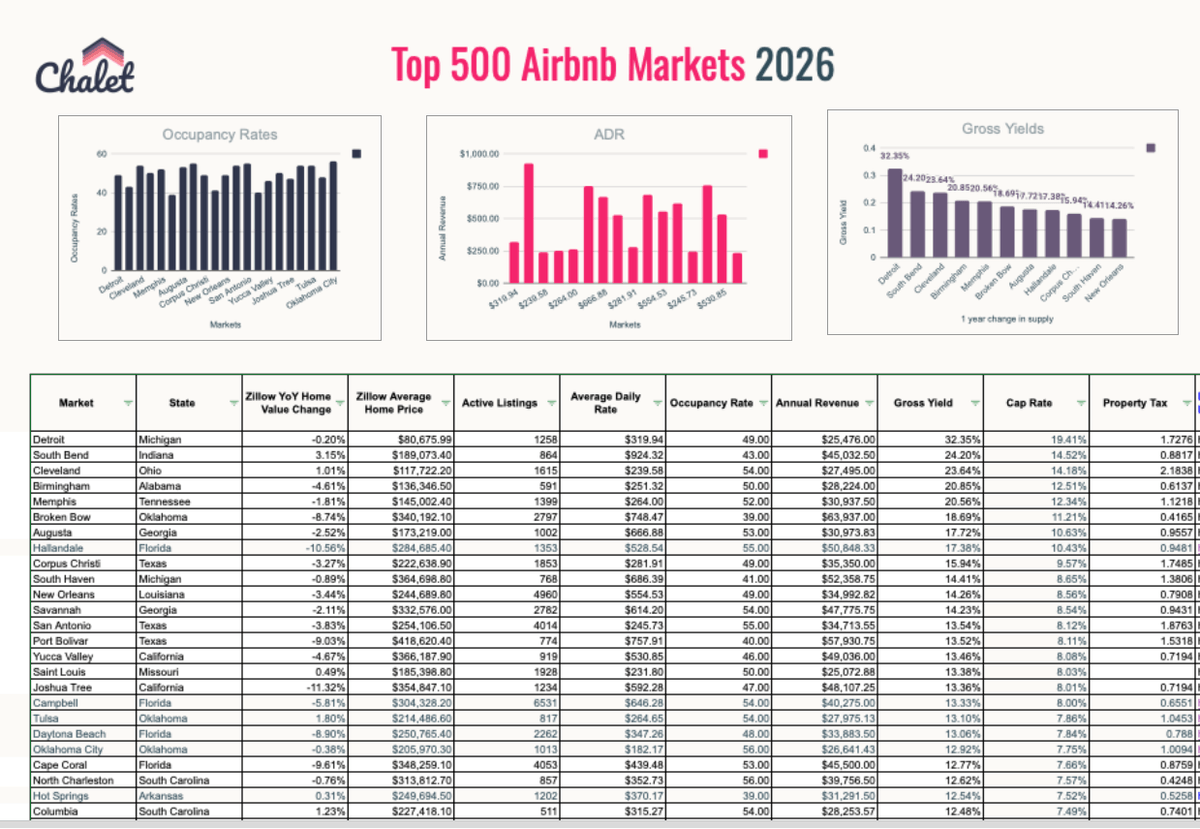
Instantly compare top 500 short-term (Airbnb) rental markets in the US
Frequently Asked Questions
Basics
What is considered a short-term rental in Chicago?
A short-term rental is any rental of a dwelling unit or portion thereof for fewer than 32 consecutive days (Checkmate Rentals).
Are STRs legal in Chicago?
Yes, STRs are legal if registered and operated in compliance with city ordinances (Truvi).
Does Illinois have statewide STR rules?
No, Illinois leaves STR regulation to local governments; Chicago sets its own rules (Checkmate Rentals).
Licensing
Is a permit required to operate an STR in Chicago?
Yes, registration is mandatory for all STRs (Truvi).
What does the permit cost?
$125 for a single unit; $250 for a multi-unit operator license (valid two years) (Truvi).
Is there an annual renewal fee?
No separate annual renewal fee is codified; the multi-unit license is valid for two years (Truvi).
Are STR licenses transferable?
No, licenses are not transferable; new owners must apply (Truvi).
Is there a cap on the number of STR licenses?
No citywide cap, but only 6 units or 25% per building may be STRs (Truvi).
Taxes
What is the total effective lodging tax for Chicago STRs?
The total effective lodging tax is 27.75% (City of Chicago Office of Financial Analysis).
Does Airbnb collect and remit all required taxes?
Yes, Airbnb collects and remits city, county, and state hotel taxes for bookings of 29 nights or less (Airbnb Help Center).
Do hosts need to remit taxes for direct bookings?
Hosts must ensure compliance for direct bookings; platforms like Airbnb handle remittance for platform bookings (Airbnb Help Center).
What is the state sales tax rate on STRs?
10.25% applies to rentals under 6 months (City of Chicago Office of Financial Analysis).
Operations
Is primary residence required for STRs?
Yes, for single-family and 2–4 unit buildings; not required in 5+ unit buildings (Truvi).
Are there minimum night stay requirements?
No citywide minimum night stay is codified (Municipal Code of Chicago).
Are there occupancy or parking caps?
No citywide occupancy or parking caps are codified; general building and zoning rules apply (Municipal Code of Chicago).
Can HOAs or condos ban STRs?
The city does not codify HOA/condo STR restrictions, but private covenants may apply (Municipal Code of Chicago).
Are there prohibited buildings or zones?
Yes, STRs are banned in Restricted Residential Zones and over 2,300 prohibited buildings (Truvi).
Enforcement
What are the penalties for non-compliance?
Fines range from $2,500 to $10,000 per offense; licenses may be suspended or revoked (Avalara).
How is enforcement carried out?
Chicago uses a licensing system and complaint response, with penalties for violations (Checkmate Rentals).
Can STRs be banned at the neighborhood level?
Yes, precincts can become Restricted Residential Zones via voter petition, blocking new STR licenses (Rental Scale-Up).
Are there recent or pending changes to STR rules?
Yes, ongoing amendments and precinct-level bans are a key risk (Rental Scale-Up).
Permit Process
Chicago requires all STR operators to register with the Department of Business Affairs and Consumer Protection. Single-unit hosts pay a $125 fee, while multi-unit operators pay $250 for a two-year license (Truvi). Registration is mandatory for rentals under 32 days. Licenses are not transferable, and new owners must reapply (Truvi). There is no citywide cap, but building-level limits apply.
Zoning
STRs are allowed citywide except in Restricted Residential Zones, which are created by voter petition at the precinct level (Truvi). In buildings with five or more units, only six units or 25% of the total may be STRs (Municipal Code of Chicago). Over 2,300 buildings are specifically prohibited from STR use (Truvi). Primary residence is required for single-family and 2–4 unit buildings.
Taxes and Remittance
Chicago imposes a 4.5% hotel tax, a 4% shared housing surcharge, a 2% domestic violence surcharge, and a 1% county hotel tax (City of Chicago Office of Financial Analysis). State sales tax (10.25%) and hotel tax (6% of 94% of gross receipts) also apply (Illinois Dept. of Revenue). Airbnb and similar platforms collect and remit these taxes for bookings of 29 nights or less (Airbnb Help Center).
Enforcement and Recent Actions
Chicago enforces STR rules through licensing, complaint response, and significant fines for violations (Checkmate Rentals). Fines range from $2,500 to $10,000 per offense, and licenses can be suspended or revoked for repeated or egregious violations (Avalara). Enforcement is strict, especially in prohibited buildings and restricted zones.
Recent Changes and Pending Legislation
On June 9, 2026, the City Council renewed a location-based ban, maintaining existing geographic restrictions (Rental Scale-Up). A 2025 proposal would allow aldermen to impose precinct-level bans directly, with the possibility for residents to overturn them by petition. Regulatory risk is highest in neighborhoods with active political shifts or new development.
Comparable Markets
- Milwaukee, WI — Consider if you want lower tax and more stable STR rules.
- Indianapolis, IN — Consider for less restrictive licensing and lower compliance costs.
- St. Louis, MO — Consider for more flexible zoning and lower tax stack.
- Minneapolis, MN — Consider for a different Midwest regulatory climate.
Sources
- City of Chicago Office of Financial Analysis: https://www.chicago.gov/content/dam/city/depts/COFA/AldermanicRequestReports/2025/COFA_Aldermanic%20Request_short%20term%20rental%20taxes%20and%20fees.pdf
- Illinois Department of Revenue Publication 106: https://tax.illinois.gov/content/dam/soi/en/web/tax/research/publications/pubs/documents/pub-106.pdf
- Municipal Code of Chicago: https://codelibrary.amlegal.com/codes/chicago/latest/chicago_il/0-0-0-2610323
- Municipal Code of Chicago index: https://codelibrary.amlegal.com/codes/chicago/latest/chicagozoning_il/0-0-0-48006
- City of Chicago Shared Housing Registrations: https://www.chicago.gov/sharedhousing
- City of Chicago Business License Forms: https://www.chicago.gov/city/en/depts/bacp/supp_info/business_licenseforms.html
- Airbnb Help Center: https://www.airbnb.com/help/article/861
- Truvi Chicago Airbnb Rules Guide: https://truvi.com/blog/chicago-airbnb-rules/
- Rental Scale-Up: https://www.rentalscaleup.com/short-term-rental-rules-chicago-croatia/
- Avalara: https://www.avalara.com/mylodgetax/en/blog/2025/07/chicago-requires-short-term-rental-operators-to-submit-monthly-data-reports-under-new-law.html
- Checkmate Rentals: https://www.checkmaterentals.com/blog/illinois-short-term-rental-laws
- Steadily: https://www.steadily.com/blog/airbnb-short-term-rental-laws-regulations-chicago
- Proper Insurance: https://www.proper.insure/regulations/airbnb-laws-illinois/
This page is research, not legal advice. Consult local counsel before acquiring or operating a short-term rental in City of Chicago, Cook County, Illinois.
Ready to evaluate Chicago as an STR market?
- See Chicago revenue data → — Get up-to-date STR performance and occupancy trends.
- Run this deal in our calculator → — Model cash flow and compliance costs for any Chicago property.
- Match with a Chicago STR agent → — Connect with vetted local experts for your acquisition.